
Key Takeaways
- Indiana law does not require a criminal conviction, charge, or investigation before a survivor can file a civil lawsuit for sexual abuse.
- Civil cases use a lower standard of proof — a “preponderance of the evidence” — than the “beyond a reasonable doubt” standard required in criminal cases.
- A criminal acquittal does not bar a civil claim; the two systems operate independently and reach conclusions using different evidence standards.
- Compensation in a civil sexual abuse lawsuit can include medical costs, lost income, pain and suffering, and punitive damages.
- Institutions such as schools, religious organizations, and employers may also be held liable if their negligence allowed the abuse to occur.
When someone commits sexual abuse, many survivors assume that if a criminal case fails or is never pursued, all paths to justice close with it. That assumption is not accurate. The civil and criminal legal systems in Indiana operate independently, and a lack of criminal conviction does not prevent a survivor from pursuing financial compensation through a separate civil lawsuit. Whether a prosecutor declined to file charges, a jury acquitted the defendant, or the criminal statute of limitations expired, a civil claim may still be viable.
Wagner Reese has represented survivors of sexual abuse across Indiana for years, helping them understand their legal rights and pursue the compensation they deserve. Our founding partners, Stephen Wagner and Jason Reese, have earned Trial Lawyer of the Year recognition, and our firm holds a Tier-One Best Law Firm ranking. If you have been affected by sexual abuse, our sexual abuse victims attorneys can walk you through your options under Indiana law.
The Key Difference Between Criminal and Civil Cases
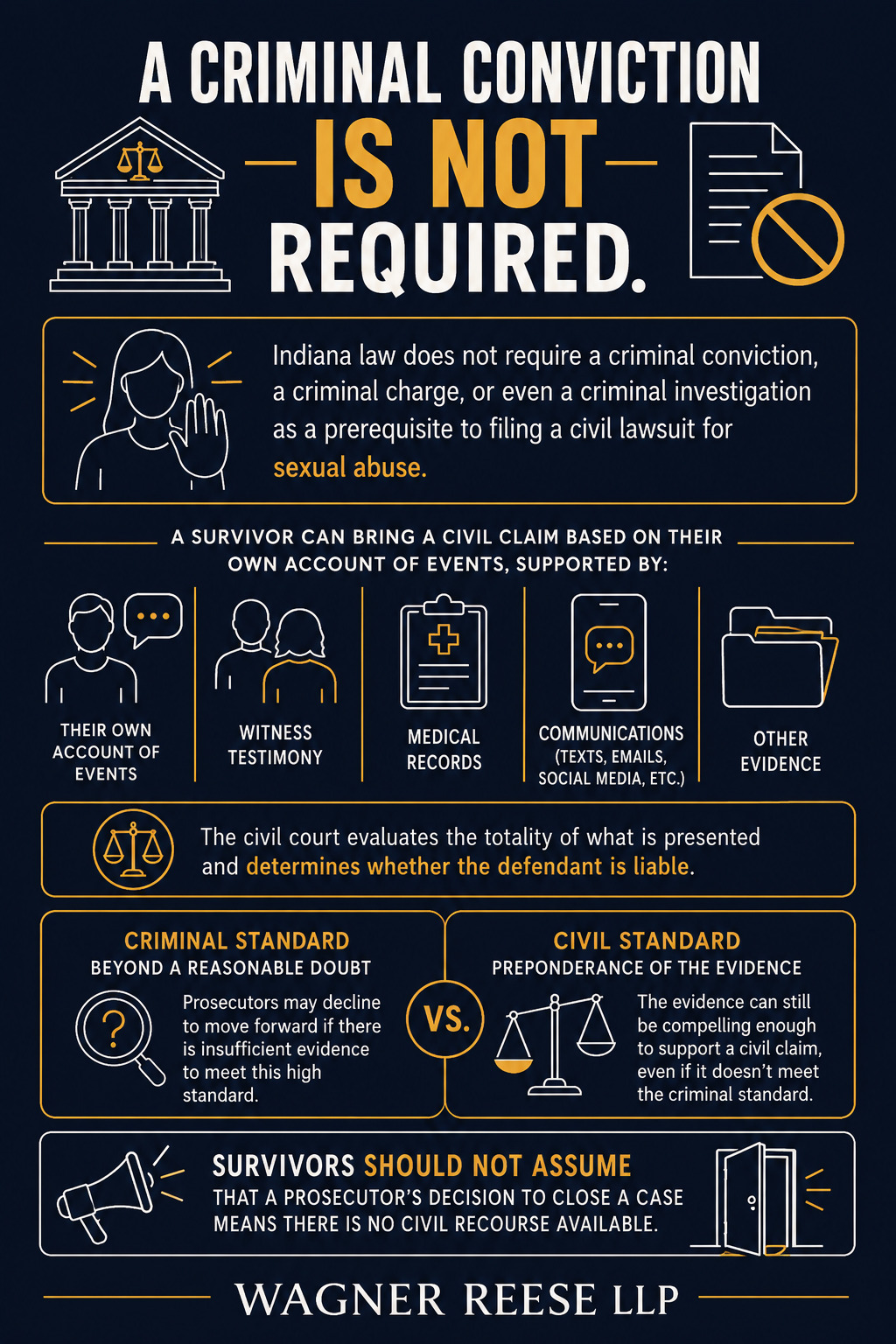
Criminal cases and civil cases serve different purposes and operate under different standards of proof. In a criminal case, the government prosecutes the accused and must establish guilt “beyond a reasonable doubt,” which is one of the highest legal standards in the system. A civil lawsuit is filed by the survivor directly and uses the lower standard of a “preponderance of the evidence,” meaning the evidence only needs to show it is more likely than not that the abuse occurred. This difference is why a defendant who was found not guilty in a criminal trial can still be held liable in civil court.
A Criminal Conviction Is Not Required
Indiana law does not require a criminal conviction, a criminal charge, or even a criminal investigation as a prerequisite to filing a civil lawsuit for sexual abuse. A survivor can bring a civil claim based on their own account of events, supported by witness testimony, medical records, communications, or other evidence. The civil court evaluates the totality of what is presented and determines whether the defendant is liable.
This is especially important in cases involving sexual battery, where a prosecutor may have declined to move forward due to insufficient evidence for the criminal standard, yet the available evidence is still compelling enough to support a civil claim. Survivors should not assume that a prosecutor’s decision to close a case means there is no civil recourse available.
What Compensation May Be Available
In a successful civil lawsuit for sexual abuse in Indiana, survivors may be entitled to several categories of damages. These can include compensation for the following:
- Past and future medical expenses, including mental health counseling and therapy
- Lost income and reduced earning capacity resulting from the trauma
- Pain and suffering, including emotional distress and psychological harm
- Loss of enjoyment of life tied to the impact the abuse has had on daily functioning
- Punitive damages, when the conduct was particularly egregious or intentional
The damages available vary based on the circumstances of each case, and an attorney can help evaluate what a specific claim may be worth.
Institutional Liability Can Expand Your Options
Civil lawsuits for sexual abuse are not limited to the individual abuser. Institutions that enabled, ignored, or failed to prevent abuse may also be held liable. Schools, religious organizations, youth programs, and employers can all face civil claims if their negligence contributed to an environment where abuse was allowed to occur. Our firm has handled cases involving clergy sexual abuse and abuse perpetrated within schools and universities, and in many of those cases, the institution bore significant legal responsibility.
Civil statutes of limitations for sexual assault vary by state, and Indiana applies specific deadlines to adult survivors as well as separate provisions for survivors who were abused as children. Acting sooner rather than later helps you preserve evidence and file within the applicable window.
When a Criminal Acquittal Does Not End the Civil Case
A not-guilty verdict in a criminal case does not create a legal bar to civil liability. The two proceedings are legally independent, and a jury that found reasonable doubt in a criminal trial did not conclude that the abuse never happened. It concluded only that the prosecution did not meet the criminal burden of proof. A civil court applies its own analysis using a different standard, and the outcome can differ significantly. Cases that involve wrongful death arising from abuse-related causes, for example, may proceed in civil court regardless of what occurred in a prior criminal proceeding.
Contact Wagner Reese LLP
Our attorneys know that coming forward after sexual abuse takes tremendous courage, and we are here to support you through every step of the legal process. With over 150 combined years of experience, Super Lawyers recognition, Best Lawyers in America honors, and a Tier-One Best Law Firm ranking, our firm brings both the credentials and the dedication that survivors deserve when seeking accountability. We work on a contingency fee basis, meaning there is no upfront cost to pursue your case.
If you are ready to explore your options, we encourage you to reach out to our team through our contact form. We serve survivors throughout Indiana and are prepared to help you take the next step toward justice.